Two Worlds, One City: The Strange Beauty of Ulaanbaatar's Unresolved Identity
You'll feel it before you can name it. Maybe it happens when your taxi driver — navigating a gleaming new overpass — has a small Buddhist prayer flag dangling from his rearview mirror and a smartphone mounted beside it running Google Maps. Maybe it hits you when you walk out of a glass-and-steel shopping mall and find yourself staring down a hillside covered in white gers, their stovepipes threading smoke into a gray sky that looks borrowed from a century ago. Whatever the moment, it lands like a quiet jolt: where exactly am I?
Ulaanbaatar doesn't resolve that question. It just keeps asking it.
For American travelers used to cities that feel more or less coherent — where history is preserved in museums and modernity is the default operating system — UB is genuinely disorienting. And once you lean into that disorientation instead of fighting it, the city becomes one of the most fascinating places you'll ever stand.
The Skyline That Doesn't Quite Add Up
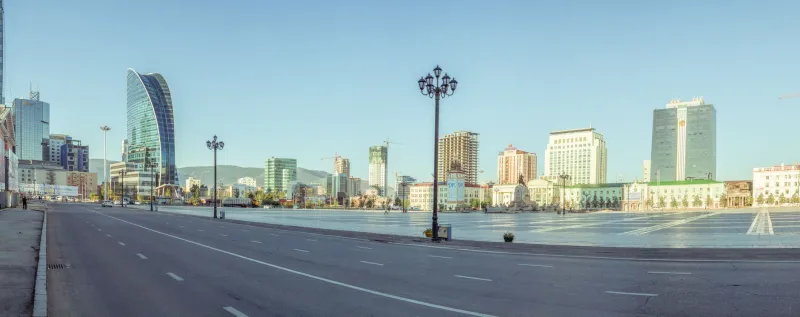
Fly into Chinggis Khaan International Airport and the drive into the city gives you your first visual clue. Downtown Ulaanbaatar has actual skyscrapers — Blue Sky Tower, the State Department Store, glass-fronted banks and hotels that wouldn't look out of place in Denver or Minneapolis. There are traffic jams that rival anything on the 405. There are craft cocktail bars, Korean BBQ restaurants, and rooftop lounges with DJs.
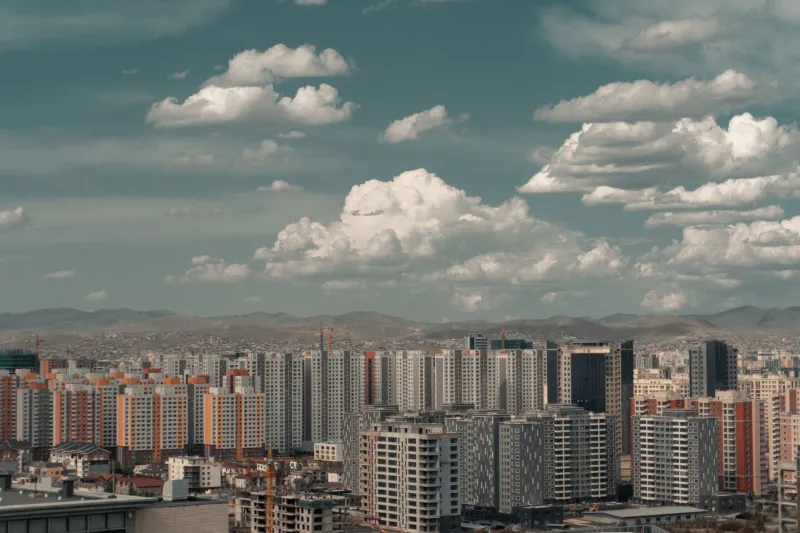
But rotate 180 degrees from almost anywhere in the city center, and the hills surrounding UB are draped with ger districts — sprawling, low-lying communities where tens of thousands of families live in traditional round dwellings, heating with coal and wood, hauling water from communal kiosks. These aren't historical reenactments. They're home to roughly half the city's population, many of whom migrated from the countryside within the last two decades when drought and harsh winters — dzuds, in Mongolian — wiped out their herds and their rural livelihoods.
The skyline, in other words, is telling two stories at once. Neither one is the whole truth.
Zaisan Hill: Where the Views Get Complicated
Climb up to the Zaisan Memorial on the southern edge of the city and you get the clearest possible view of this contradiction. The memorial itself is a Soviet-era monument — a circular mosaic celebrating Mongolian-Soviet friendship, ringed by a massive mural depicting soldiers, cosmonauts, and workers in that unmistakable socialist-realist style. It's Cold War kitsch, and it's genuinely striking.
But look out from the platform and the panorama below you is something else entirely: the downtown towers glinting in the sun, the ger districts spreading across the slopes, and — if you time it right — a haze of coal smoke settling over everything like a reminder that none of this is particularly tidy or resolved. Mongolians come up here to jog, take selfies, and watch the sunset. Tourists come up here and end up standing still for a long time, just trying to process what they're seeing.
That feeling? That's Ulaanbaatar working on you.
The Spiritual Underground (That's Also Completely Visible)
Walk around the Gandan Monastery complex on any given morning and you'll find monks in saffron robes conducting rituals that predate the Mongol Empire. Worshippers circle the temple clockwise, spinning prayer wheels, murmuring sutras. The air smells like juniper incense. It is, by any measure, ancient.
Then check your phone and notice that the monastery has a Facebook page with regular updates. The monk near the entrance is texting someone. A tour group is posing for photos that will be on Instagram within the hour.
This isn't desecration — it's just life in a city that never fully separated the sacred from the everyday. Buddhism was suppressed for most of the Soviet period, its monasteries destroyed and its monks killed or imprisoned. What exists today is a revival, rebuilt from near-extinction, and Mongolians practice it with an urgency that feels less like habit and more like reclamation. The fact that it coexists with smartphones and social media isn't a contradiction to them. It's just Tuesday.
Naran Tuul: Capitalism, Nomad-Style
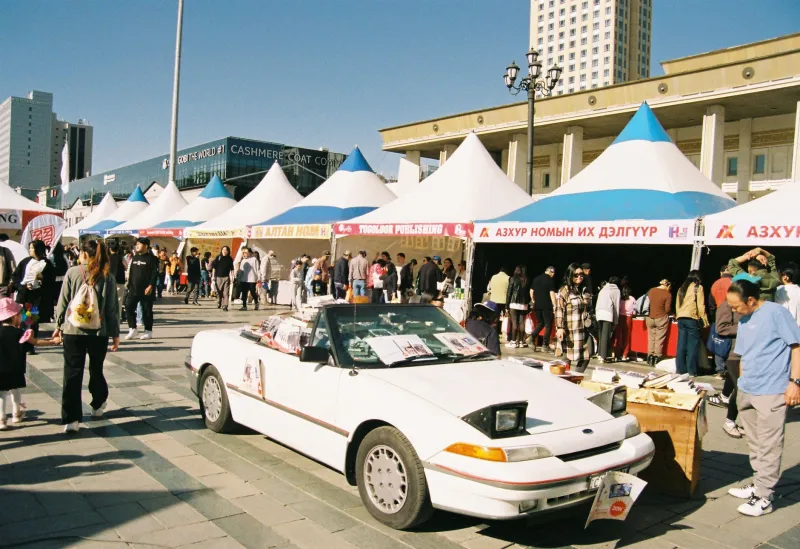
If you want to understand how Mongolia's economic transformation feels at street level, spend a few hours at Naran Tuul Market — the massive open-air bazaar on the city's eastern edge that locals call the Black Market (the name is historical, not sinister). You can buy a saddle, a solar panel, a deel (traditional Mongolian coat), a used motorcycle engine, dried meat, and a cashmere sweater, all within a few hundred meters of each other.
What you're watching is a nomadic trading culture that adapted to a cash economy without ever fully abandoning its instincts. The haggling is real. The social dynamics — who defers to whom, how deals get sealed, what counts as a fair exchange — still carry echoes of a society organized around herds and seasonal migration rather than fixed storefronts and annual leases. It's capitalism with a completely different cultural operating system underneath it, and it's one of the most alive, chaotic, and weirdly joyful places in the entire city.
Why Americans Find This So Hard to Categorize
Here's the thing about traveling from the US to Ulaanbaatar: Americans are pretty good at slotting places into familiar categories. Developing country. Emerging economy. Historical destination. Adventure travel. But UB resists all of those frames simultaneously.
It's not poor enough to feel like a purely developing-world experience — the infrastructure, the food scene, the connectivity are all more sophisticated than most visitors expect. It's not wealthy enough to feel like a typical cosmopolitan capital. It's not old enough, in its current form, to feel like a heritage destination, and it's not new enough to feel like a clean-slate boomtown.
What it actually is: a city in the middle of becoming something, where that process of becoming is fully, visibly, uncomfortably on display. The tension between the nomadic past and the urbanized present hasn't been smoothed over with a coat of tourism-friendly polish. You see the seams. You feel the friction. And if you're paying attention, you start to understand that the friction is the identity — not a problem to be solved but the actual texture of what Mongolian modernity looks and feels like right now.
The Best Reason to Come
Most cities worth visiting have figured out, at least partially, what they are. They've made peace with their history or bulldozed it, settled into a groove, developed a tourist-friendly narrative about themselves. Ulaanbaatar hasn't done any of that, and it probably won't anytime soon.
That's not a flaw in the destination. It's the destination.
Come here if you want to feel genuinely surprised. Come here if you want to stand in a place where the 13th century and the 21st century are still actively negotiating. Come here if you want to be reminded that cities, like people, don't have to have their contradictions resolved to be worth knowing.
Ulaanbaatar will disorient you, charm you, frustrate you, and occasionally knock the breath out of you with its strange, stubborn beauty. It won't explain itself. But if you give it a few days, you might find yourself not wanting it to.